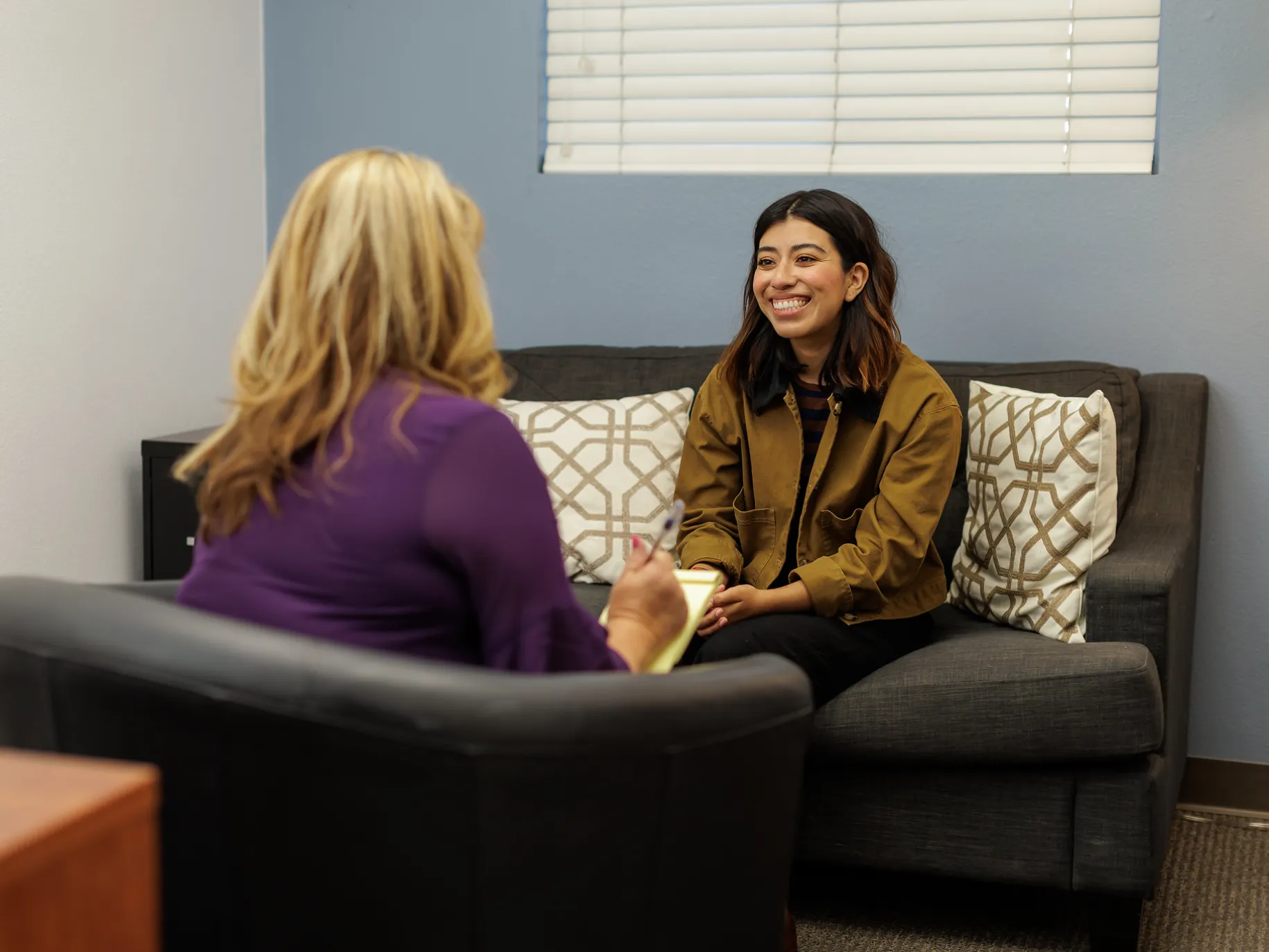
Azusa Pacific University’s Community Counseling Center (CCC) was started in 1988 for outreach, service integration, and behavioral health. Since then, the CCC has continually provided affordable mental health services to the Azusa community and beyond while equipping graduate students with hands-on clinical experience in therapy and psychodiagnostic assessments. Operated primarily by Master’s in Marriage and Family Therapy (MFT) and Clinical Psychology (PsyD) student therapists, the clinic offers support for a wide range of mental health challenges while fostering meaningful relationships within the university and the surrounding community.
Providing both clinical support and professional development opportunities, the CCC allows APU students to provide low-cost services to those in need in the community. Andrea Munoz, PsyD ’21, Associate Director of the CCC, explained that the clinic serves as an important training ground for aspiring therapists while also making counseling more accessible for residents. The CCC is often a student’s first opportunity to work directly with clients in a clinical setting. Student trainees are supervised by professional therapists, enabling them to handle multiple scenarios. “The clinic is fully run by student-therapists,” said Munoz. “We tackle challenges like anxiety, living situations, depression, grieving, and life transitions.”
For PsyD students pursuing careers in therapy, the clinic also serves as a space to apply classroom learning in real-world settings. Gregory Sanchez ’29, a PsyD student trainee at the CCC, said his experience at the clinic has played a significant role in preparing him for his future career. “My time at the Azusa Pacific Community Counseling Center has been instrumental in developing my skills as a future clinical psychologist,” said Sanchez. He explained that the clinic gave him opportunities he had not previously experienced in his academic training. “Until recently, I had not had the opportunity to work with clients across the entire lifespan, and the APU CCC has allowed me to hone my skills as a therapist,” said Sanchez.
Along with training students, CCC employees have worked to create a welcoming environment designed to make clients feel comfortable, especially those who may feel uncertain about beginning therapy for the first time. “It can be intimidating if you’ve never been to therapy before, but we’re here to help you through the healing journey,” said Munoz. Sanchez highlighted the impact of collaboration among fellow therapists and trainees. “The most interesting aspect of my time at the APU CCC is the peer-to-peer interactions with other clinicians who helped me refine my skills,” said Sanchez.
The clinic also prioritizes accessibility through services in other languages and income-based payment options. “We offer multilingual services for the community, with languages like Spanish, Italian, Arabic, and Korean,” said Munoz. The languages vary, with employees doing their best to support people from different backgrounds.
We also operate on a sliding scale. What that means is that our fees are income-dependent, so if a person has a lower income, we accommodate them with affordable treatment options.Andrea Munoz, PsyD '21
The CCC provides specialized training opportunities for student therapists as they continue developing their clinical skills. Sanchez noted that these experiences helped reinforce lessons learned within APU’s PsyD program. “I received training in Trauma Focused Cognitive Behavioral Therapy (TF-CBT), Seeking Safety, Play Therapy, and Eye Movement Desensitization and Reprocessing (EMDR) Therapy,” said Sanchez. “These trainings further solidified the foundational skills taught to me by my esteemed faculty in the PsyD Program at APU.”
The CCC aims to provide support quickly and efficiently compared to many traditional mental health clinics. “The time period between the first phone call and the first session is about two weeks,” said Munoz. “Seeing a therapist at the CCC can be a much quicker process than most mental health clinics, which can often take several weeks or even months.”
Beyond counseling sessions, the CCC remains involved in the broader Azusa community through outreach initiatives and partnerships, including offering free services for students in the Azusa Unified School District and Duarte Unified School District (PK-12). “We are a part of All in for Azusa, which is a city-led health collective that allows us to stay present in the community,” Munoz said. “Our therapists are encouraged to participate in and attend outreach at school open houses, school lunch events, outreach programs, and conferences.” Munoz also clarified a common misconception regarding the center’s purpose. “Many people mistake us for the University Counseling Center, which is designed specifically to serve APU students,” said Munoz. “While we can see students, we primarily serve the community as a whole.”
As mental health awareness continues to grow, Munoz encouraged individuals not to let fear or uncertainty prevent them from seeking help. “It’s completely normal to feel nervous about reaching out for support. I’d encourage anyone who wants help with their mental health to not let that stop them,” said Munoz. “If calling feels overwhelming, there are online options to get started with the clinic. Most importantly, we understand how difficult it can be, and we’re here to help every step of the way.” Sanchez also reflected positively on the clinic’s role in shaping future clinicians while serving the community. “The APU CCC is a great place to get introduced to the clinical work that therapists and clinicians will provide to their clients,” said Sanchez.
Looking ahead, Munoz said the center hopes to continue strengthening its presence within the APU and Azusa communities. “The CCC is focused on building meaningful connections within the APU community and looks forward to continued growth in the future,” said Munoz. The center continues to emphasize accessibility, connection, and professional growth as it expands its impact throughout the Azusa community.
By combining affordable counseling services with hands-on training opportunities for future clinicians, the APU CCC continues to serve as both a valuable community resource and an important part of APU’s commitment to service, compassion, and holistic care.