Azusa Pacific University is more than just a place for students to earn a degree that will help them pursue their dream jobs. For Lesa Brackbill ’05, MA ’24, APU was also a place to see the value of lifelong learning and realize the importance of allowing faith to grow and change as she did. Now the director of advocacy at Patient Advocacy Strategies, a board director for KrabbeConnect, a school board member of Derry Township in Hershey, PA, a twice-published author, and the leading force behind PA’s Act 133 of 2020, Brackbill’s passion for helping others began during her time at APU.
Brackbill visited APU while exploring colleges and fell in love with the community and atmosphere. APU was the only university she applied to because she knew it was where she belonged. Brackbill has always had a passion for politics, and she graduated with a bachelor’s in political science. She spent a few years in Southern California before moving to Pennsylvania, where she met her husband, Brennan, and began working at a lobbying firm in Harrisburg. However, she soon began to feel like politics and lobbying were not her lifelong callings.
In July 2014, Brackbill and her husband welcomed their first child, a baby girl named Victoria. Six months later, Tori was diagnosed with Krabbe disease, a rare neurological disease that can only be treated if caught within a baby’s first 30 days of life. “We found out she was dying and there was nothing we could do about it because she wasn’t screened for Krabbe disease at birth,” Brackbill said. “What we didn’t know that day is that newborn screening is one of the most successful public health initiatives in the U.S., and it identifies approximately 12,000 babies that require immediate intervention each year. But every state decides which conditions to include on its panel, meaning that your opportunity for treatment is determined by geography. It was traumatic knowing we could have saved her if she had been born in a state that had done screening for Krabbe disease.” At the time, not every state included Krabbe disease on its newborn screening panel, and Brackbill saw a need for change so that other parents would not have to go through what she and her husband went through in losing their child. Victoria passed away on March 27, 2016.
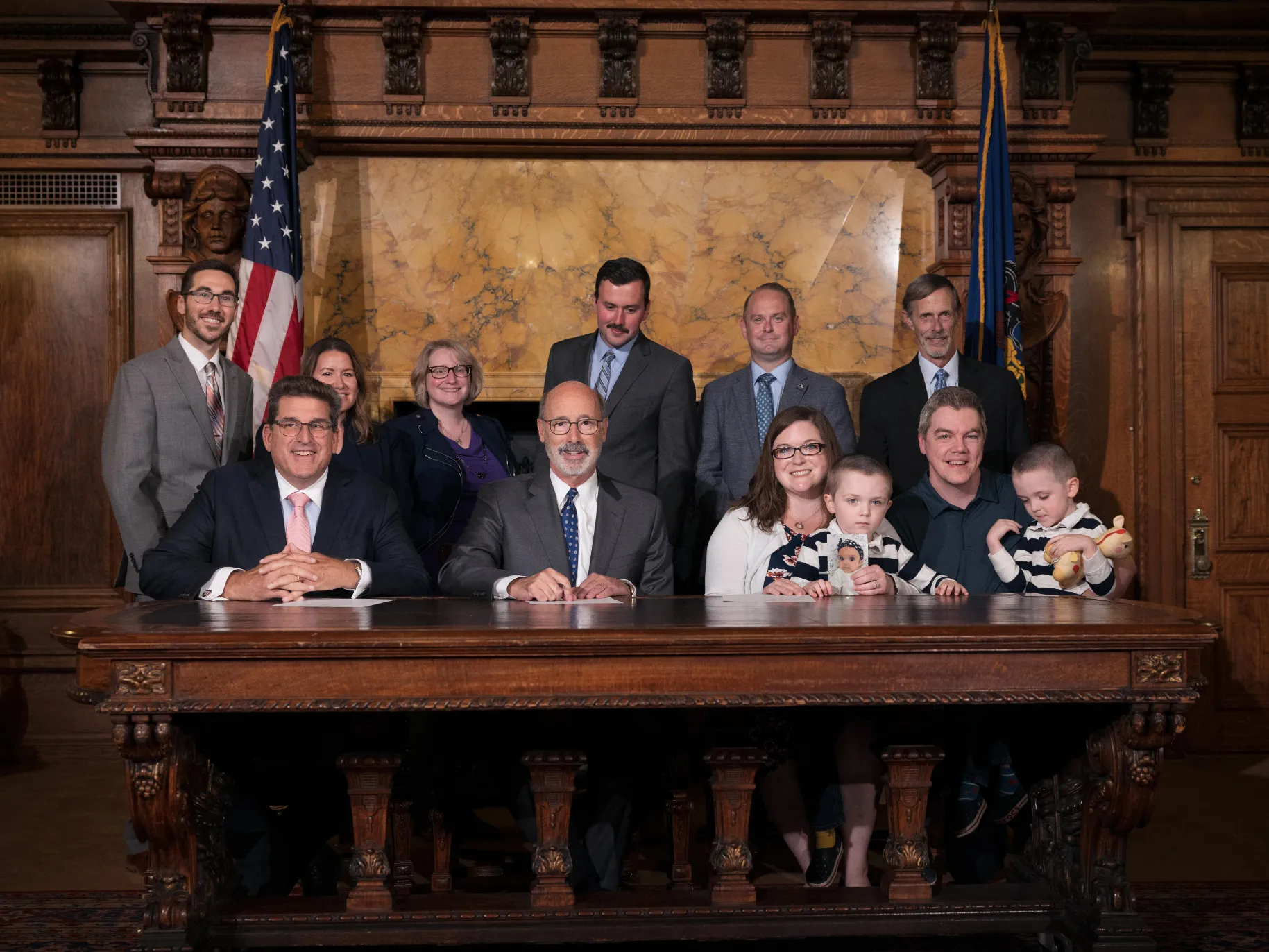
Healing took time, and Brackbill knew that there had to be some good that she could do moving forward. After Tori’s passing, Lesa began to pursue legislative change in Pennsylvania, with the first bill being introduced in April 2017. Brackbill, with the help of dedicated public servants behind the scenes, proposed a bill to strengthen the newborn screening program by enabling the advisory board to independently add conditions to the state panel and by shifting funding from the state budget to insurance as part of the birthing bundle, which would ensure faster addition of life-saving conditions. While advocating for newborn screening, Lesa wrote her first book, which was released right before she and her husband welcomed their twin boys in 2018. It took three legislative attempts over the course of five years, but Lesa found success in November 2020 with what became Pennsylvania Act 133 of 2020. “The bill aligned Pennsylvania with the federal list of recommended conditions and enabled our advisory board to follow science, not bureaucracy, to ensure that we were giving babies in Pennsylvania the best chance at a healthy life,” Brackbill said. Not only did her efforts help parents and children in the state, but they also showed her how strong she was. Brackbill had successfully passed a bill during a global pandemic while raising toddler twins.
Only 67 days after the bill was passed, a set of twins was born in Pennsylvania and
diagnosed with Krabbe disease through newborn screening. Thanks to the new screening
requirements, the two were the first in the world to receive gene therapy for Krabbe
disease and are doing well today. For Brackbill, this was great news, but it was also
emotional. She found out that the boys were born on the same day her daughter had
been born six years before. “I got to meet the boys in person last summer,” Brackbill
said.
Two years later, Brackbill worked behind the scenes to support and advise a group of mothers who were working to improve Pennsylvania’s hearing screening regulations for children, and Act 29 of 2022 was successfully passed. “I’m now helping other rare disease groups with advancing newborn screening state by state,” Brackbill said. “It’s such a narrow and niche area to become an expert in, but it means the world to these families.” Brackbill’s twins are eight-years-old and have rare genetic hearing loss, so advocating for children has continued to be a vocational and personal passion for her. Last November, she was elected to the Derry Township School Board with the hope of overseeing and advocating for students with special needs. “In times of uncertainty, especially in rare disease advocacy, we need to take our losses and channel them into a legacy for kids who can’t do it themselves.”
Until she was working in the rare disease space, Brackbill didn’t realize how important and relevant the skills she’d learned during her undergraduate years at APU would be. “College wasn’t just four years of my life,” she said. “What I learned at APU has been a part of my everyday life ever since, and I love how we were taught to approach learning and think about things in new ways.” As she began taking on more behind-the-scenes roles in advocacy and mentoring, Brackbill decided to continue her education at APU because of the lasting impact the community and curriculum had on her. Brackbill earned her master’s in Strategic Communication in 2024. “APU’s program wasn’t like a typical marketing or public relations program,” she said. “It shows you how to analyze data, create ethical messages, and understand communication theory. It also taught me how to teach others. I still have all of my textbooks in my office at work and reference them often because they are so useful.”
As if Brackbill’s accomplishments in the rare disease and political arenas weren’t impressive enough, she is also a published author. Her first book, Even So, Joy: Our Journey Through Heartbreak, Hope, and Triumph, is about her daughter, Tori, and the journey of choosing joy, with faith at its root. Published this past March, Brackbill’s second book, A Brighter Blueprint: The Twelve Threads of Effective Advocacy, is about ethically working towards a brighter future through advocacy. Much of the book is informed by what Brackbill learned in her ten years of advocacy and her classes at APU, and all of it is informed by her faith, even though the book isn’t overtly Christian. “I don’t know what the future holds, but I know that the Christian values I was taught matter,” she said. “The foundation of everything I do is humility, which is important in a specialized field like advocacy, and in our society as a whole. We need to normalize the notion that our ideas might be wrong, and there may be better solutions.”
Brackbill is an inspirational woman in the way she aspires to be a lifelong learner and shares that knowledge with others through her writing, and in the way she balances a career in an emotionally intense field while raising twin boys. “This is not the journey I thought I would be on, but on diagnosis day, it was like I saw a movie montage,” she said. “It all came together. I realized that this is why I have a political science degree and lobbying experience. This is why I am a passionate person and have a strong sense of justice.” Brackbill reflected that in her senior year at APU, her top StrengthsFinder result was Belief, which correctly indicated that she had to be passionate about what she was doing and believe in the cause. Her faith and strong belief in the possibility of a brighter future for all children has pushed her to make changes that continue to impact and inform so many throughout Pennsylvania and the country.