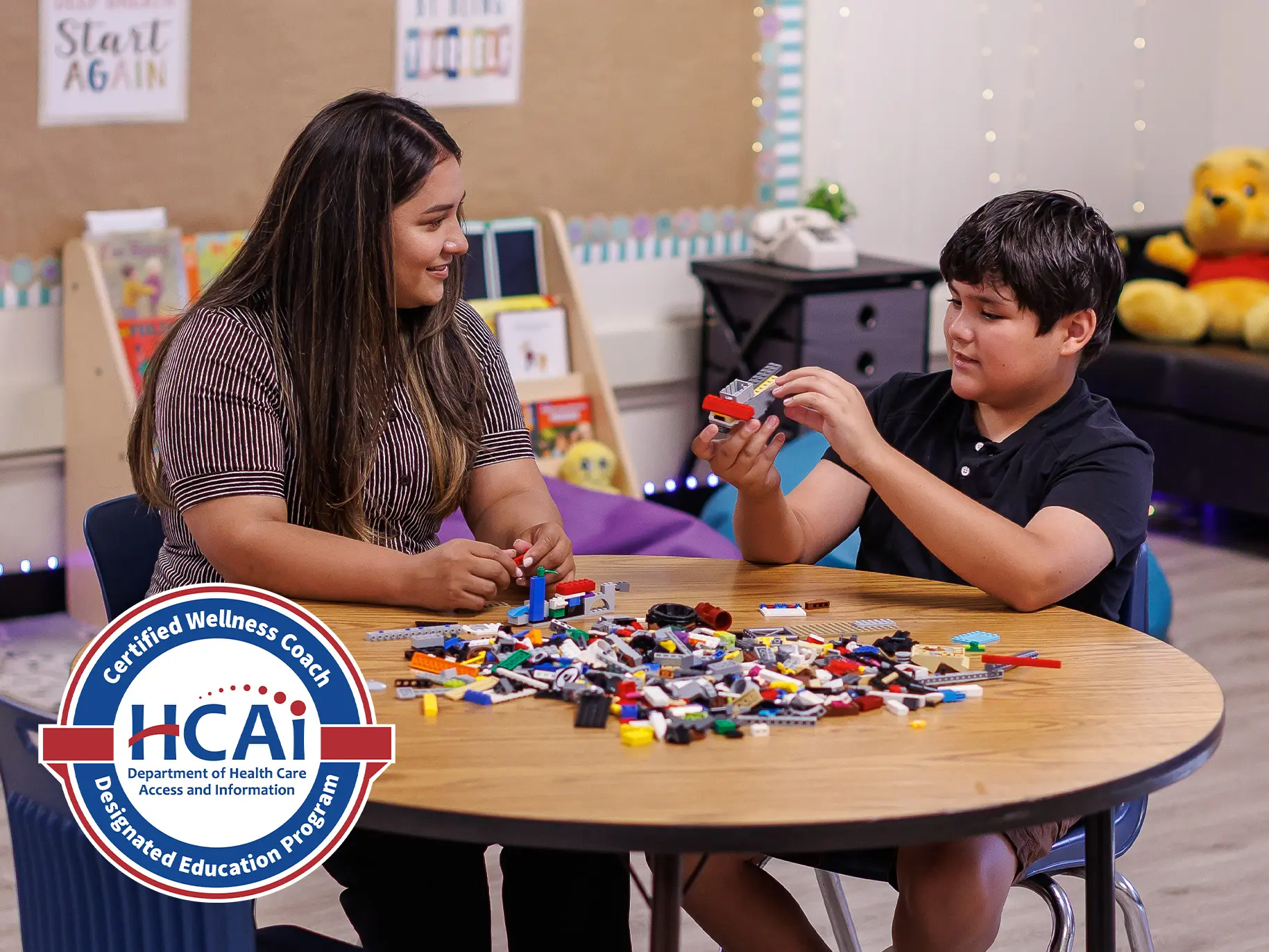
Azusa Pacific University (APU) received a $312,500 grant from the California Department of Health Care Access and Information (HCAI) to train students in the university’s Bachelor of Social Work (BSW) program to become Certified Wellness Coaches. This two-year grant supports BSW curriculum development, preparing graduates with Certified Wellness Coach (CWC) certification to address the growing behavioral health needs of children in school settings across the state.
APU is among the first private universities in California to implement this professional workforce pathway. The state-certified profession expands California's capacity to support children and youth up to age 25. Certified Wellness Coaches work alongside behavioral health professionals, teachers, and student support services on school campuses, or coordinate care to support the mental and behavioral health and well-being of children and youth by providing non-clinical services where they live, study, and work. BSW students will receive the specialized training necessary to support children both socially and emotionally.
An independent evaluation report by Mathematica found that as of February 2026, California has certified more than 4,000 Wellness Coaches, with thousands more needed to support children and youth across America’s most populous state. Data shows that Certified Wellness Coaches expand early intervention services, improving student emotional regulation, school attendance, engagement, and perceptions of safety and belonging.
Early Intervention for California’s Youth
“It’s all about providing early intervention so we can offer support before issues escalate,” said Mary Rawlings, PhD, LCSW, interim BSW director and principal investigator for the grant. “A student may be struggling with anxiety, worrying about their parents’ health issues, or any number of family challenges. That’s where a Certified Wellness Coach can come alongside the student, refer them to resources, and create educational support spaces to meet their needs.”
Certified Wellness Coaches provide six core services: wellness promotion and education, screening, care coordination, individual support, group support, and crisis referral. By expanding capacity for prevention and early intervention, CWCs complement existing behavioral health teams, preventing strain at the upper levels of the system, where children’s needs become more intense, and fill in some of the behavioral health gaps that exist today.
“Often, you’ll have one social worker assigned to a school with 300 or more students, so this role is designed to provide a buffer by offering educational coaching, support groups, psychoeducational groups, guidance on managing anxiety, and social-emotional education for the students,” Rawlings said. “That support allows the social worker—the master’s-level clinician—to take the highest-need cases by addressing the lower-level cases sooner.”
Seamless Integration into the BSW Curriculum
Funded through April 2028, the HCAI grant supports faculty and curriculum development, including a new advanced case management course. The curriculum requirements to become a CWC are embedded in APU’s BSW coursework, with students taking Health Psychology as their elective, adding no extra units to their major. In short, students graduate on time by completing all necessary certification-ready coursework, ensuring they are fully eligible to apply and increasing employment opportunities without any additional financial cost to their degree.
All of APU’s BSW students already complete a 400-hour practicum, and for the Certified Wellness Coach pathway, they must complete their field experience in school-linked/school-based organizations, nonprofits, community organizations, and or health centers/clinics that work with children and youth. By completing this practicum, they will have exceeded California’s 400-hour requirement for CWC Level I certification. APU’s BSW program has 19 existing partnerships with local school districts and family organizations for these practicum placements.
“These partnerships are one of our BSW program’s biggest strengths to support student preparation, guaranteeing them the opportunity to develop their skills under the supervision of trained professionals. Practicum placements give students a really strong foundation in supporting behavioral health needs,” Rawlings said. “They also support APU’s commitment to meeting the needs of our communities and the children and families in them.”
Before their internships, APU students gain practical experience mentoring local at-risk middle schoolers and leading support groups. The HCAI grant will provide additional specialized training for students and will support a grant coordinator, community college outreach, and crisis simulations using standardized patients.
Our social work program prepares graduates to be ready for entry-level professional practice. This certification is an extra layer on top of that, really focusing on practice-readiness for children and youth.Mary Rawlings, PhD, LCSW
Fast-Tracking Advanced Degrees: The 4+1 MSW Pathway
For students seeking to advance their knowledge, skills, and employability, APU offers an accelerated Master of Social Work (MSW) 4+1 program. If students choose this pathway, they can complete another 400-hour practicum as part of their MSW program, allowing them to advance their Certified Wellness Coach certification to Level II, expand employment opportunities, and earn higher pay.
“The way our social work program is structured is beneficial to students because with an undergraduate degree from an accredited social work program, it allows graduates to bypass the foundation curriculum from year one in the graduate program and go straight into the specialization year, graduating with their BSW and MSW in just five total years,” Rawlings said. “Choosing the 4+1 pathway not only saves them time and financial cost, but also better equips them to serve the behavioral health needs of children and youth across the state.”
As APU prepares to welcome its first incoming class of social work students who will complete the Certified Wellness Coach pathway, Rawlings reflected on the impact she hopes to see through this new program.
“APU’s social work students already have a tremendous reputation with our local school districts and partner organizations,” Rawlings said. “My hope is that school districts across California will continue to hire our graduates to make a difference in the lives of students in our communities. Many schools and social workers want to provide extra support services, but just haven’t had the capacity to do so. Our graduates will help fill these gaps as impactful Certified Wellness Coaches.”
About the Department of Health Care Access and Information
The Department of Health Care Access and Information (HCAI) advances health care access through more affordable services and safe hospitals staffed with a workforce that represents California. The healthcare data HCAI compiles and disseminates empowers leaders to make informed policy decisions, its health facility building teams ensure Californians can access care within resilient facilities, and its affordability programs aim to improve access to affordable care by providing generic drugs at low prices and setting spending growth targets to help slow the rising costs of health care. HCAI also protects consumers by investigating complaints about hospital financial assistance and debt collection policies, notices, and website requirements to ensure qualified patients have access to help paying their hospital bills.
About Azusa Pacific University
Since 1899, Azusa Pacific University, a top Christian higher education institution in the nation, has helped students discover their higher calling to impact the world for Christ. Featuring world-class faculty, an APU education leads to lifelong transformation and eternal impact. APU offers 59 bachelor’s degrees, 34 master’s degrees, 35 certificates and credentials, and 7 doctoral programs to more than 7,000 students at the university’s main campus in Azusa, several regional locations across Southern California, and online. Learn more at apu.edu.